
Social Stories for Kids With Autism: Helping Kids Navigate Everyday Situations


For many kids with autism, knowing what to expect can make everyday situations feel much more manageable. A change in routine, a new experience, an unfamiliar social situation, or even something that seems simple to an adult can bring uncertainty for a child who has difficulty understanding what is going to happen next.
Social stories for kids with autism can provide some of that missing information in a clear, visual, and predictable way.
Social stories use simple language and often pictures or other visual cues to walk a child through a situation, explain what they might experience, and help them understand possible ways to respond. Parents, teachers, and other caregivers can use them to prepare kids for everything from going to school or visiting the dentist to managing emotions, taking turns, trying something new, or understanding social expectations.
Because social stories can be read ahead of time and revisited as often as needed, kids have an opportunity to become familiar with an experience before they are expected to navigate it.
What Are Social Stories for Autism?
Social Stories were originally developed by Carol Gray to help autistic individuals better understand social situations and experiences.
Rather than simply telling a child what they should or shouldn't do, a social story provides information and context.
For example, telling a child, "You need to wait your turn," gives them a direction.
A social story can go further by explaining what taking turns means, what other people may be doing while the child waits, what waiting might feel like, and what the child can do while waiting.
That extra information can be especially valuable for kids who benefit from concrete explanations and visual learning.
A social story might include:
What is going to happen
Where something will happen
Who will be there
What the child might see, hear, or experience
How the child or other people might feel
What choices the child can make
What the child can do if they need help
The goal isn't simply to get a child to comply with an adult's expectations. A useful social story helps the child better understand the situation.
Why Social Stories for Kids With Autism Can Be Helpful
Think about how much easier it is to walk into an unfamiliar situation when someone has already explained what to expect.
Kids benefit from that information too.
Children with autism may have difficulty interpreting social cues, adjusting to unexpected changes, understanding another person's perspective, or figuring out the unwritten expectations surrounding a situation. Sensory differences can add another layer of uncertainty.
A fire drill, for example, isn't simply "walking outside with the class." There may suddenly be an extremely loud alarm, teachers giving directions, kids moving quickly through the hallway, and a change from the normal classroom routine.
A social story can explain those details ahead of time.
The same principle can apply to much smaller everyday experiences.
A child may benefit from a story about getting a haircut because the cape, scissors, clippers, unfamiliar smells, and someone touching their head are all part of the experience. Another child may need help understanding what happens when a friend doesn't want to play the same game.
By making some of the unknowns more predictable, autism social stories can give kids information they can use when the real situation occurs.
Social Story Examples for Everyday Life
One of the great things about social stories is how many different situations they can address.
At home, you might use a social story to help with getting ready in the morning, bedtime, having a babysitter, using the bathroom, getting dressed, sharing with a sibling, or handling a change in the family's plans.
Predictability can be particularly helpful at the beginning of the day. If mornings are challenging in your home, these morning routine strategies for neurodivergent and anxious kids offer additional ways to make the transition into the school day easier to understand and manage.
At school, social stories might address:
Riding the school bus
Following classroom routines
Asking for help
Taking turns
Keeping appropriate personal space
Handling a fire drill
Working with a substitute teacher
Joining other kids in play
Managing frustration
Moving from one activity to another
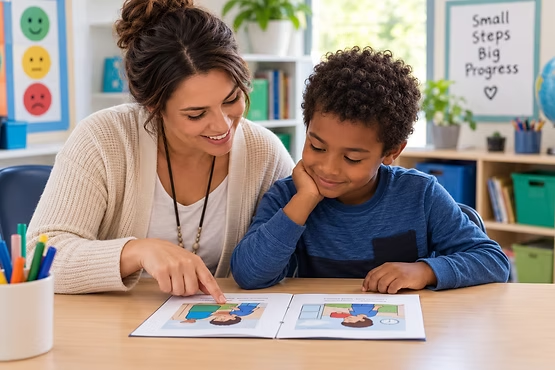
Social stories can also help explain some of the less obvious parts of interacting with other kids. Taking turns, joining a game, handling disagreements, and understanding that a friend may have a different idea are all skills that children develop over time. You can find more ideas for helping kids build healthy friendships and social skills.
Social stories can also be useful before less frequent experiences such as getting a haircut, visiting the dentist, going to the doctor, attending a birthday party, traveling, or starting at a new school.
They aren't limited to routines and social skills, either. Social stories can help children better understand emotions and self-regulation.
A story might help a child recognize what anger feels like in their body, understand that everyone feels angry sometimes, and identify choices they can make when those feelings begin to build.
Using Social Stories to Prepare Instead of React
Timing matters.
Social stories are generally most useful when children have an opportunity to look at them while they are calm and able to take in the information.
If your child has a dentist appointment on Friday, for example, you might begin reading a dentist social story several days beforehand. Your child can become familiar with the sequence of events without simultaneously having to manage the sights, sounds, sensations, and emotions of actually being at the dentist.
The story can then be reviewed again closer to the appointment.
This is one reason visual supports can be so helpful for kids. They don't disappear as soon as an adult finishes speaking. A child can look at the information again and again.
Knowing what to expect may be especially helpful for children who become anxious about unfamiliar situations or changes in routine. If this is something your child experiences, you can also read about supporting kids who experience anxiety.
The goal isn't to guarantee that a child will feel completely comfortable with an upcoming experience. It's to give them useful information beforehand so fewer parts of the situation are unfamiliar.
Free Social Stories for Autism
You don't necessarily need to start by creating your own stories.
There are free social stories for autism available that cover many common situations kids encounter at home, at school, and in the community.
AutismWorks offers a collection of free social stories for autism that parents can use to explore different topics and find stories that fit their child's needs.
Starting with a ready-made story can also help you see what your child responds to. Some kids pay close attention to the pictures. Others focus more on the words or want to read the same story repeatedly.
The important part is finding a format that helps your child understand the information.
How to Use Social Stories With Your Child
You don't need to turn a social story into a lesson or quiz.
Sit with your child and read through it together. Keep the experience relaxed and give your child time to look at the pictures and process the information.
Depending on your child's age and communication style, you might talk briefly about what is happening in the story or connect it to something familiar.
For example:
"That's like the waiting room at your doctor's office."
Or:
"Your school has a loud fire alarm like the one in this story."
You can also personalize a story when appropriate. If the story says "my teacher," you might use the teacher's actual name when you read it. If your child already has a strategy that works well, such as wearing headphones in a noisy environment or asking for a break, connect that familiar strategy to the situation.
Most importantly, don't expect a social story to instantly change a child's behavior.
Kids still need practice, repetition, support, and accommodations. A social story is one tool that can help make expectations and experiences easier to understand.
Social Stories and Visual Learning
Many kids with autism respond well to information they can see.
Visual information can make an abstract idea more concrete. Instead of repeatedly reminding a child to "calm down," "make a good choice," or "think before you act," a visual can break that idea into something the child can actually see and revisit.
The same principle applies beyond social stories. Visual tools that help kids stop and think can help children connect their actions, choices, and possible outcomes in a more concrete way.
Visual supports can be particularly useful when several things are happening at once and a child has difficulty processing lengthy verbal explanations.
They also give children something they can return to. An adult's spoken explanation is gone once it has been said. A visual remains available.
That doesn't mean every autistic child is a visual learner or that every child will respond to social stories in the same way. As with any support, the important thing is paying attention to what works for the individual child.
Choosing the Right Social Story for Your Child
Not every child needs the same information, and not every social story will be a good fit.
Look for stories that are clear, age-appropriate, easy for your child to understand, and relevant to the actual situation you're trying to support.
A preschooler learning what happens during a haircut needs something very different from an older child learning how to handle a disagreement with a friend.
It's also worth considering whether the story respects the child's experience.
If a situation is genuinely difficult because of noise, crowds, sensory input, anxiety, or communication challenges, simply telling a child how they're expected to behave misses an important part of the picture.
A helpful story acknowledges what the child may experience while giving them understandable information and practical choices.
You may also find that a story needs to be adjusted as your child becomes more familiar with a situation or develops new skills. The story should support the child—not require the child to fit a one-size-fits-all script.
More Social Stories for Kids
Once you see how your child responds to social stories, you may find that they're useful for many different situations.
Social stories aren't about scripting every moment of a child's life. They're about making situations easier to understand.
And sometimes, knowing what's coming next—and having a clearer idea of what to do when it happens—can make a big difference for a child.
Helpful Social Story Printables:
You may also like these related posts:

All blog content shared through HealthSmart! Kids is for informational purposes only and not to be construed as medical advice. Always talk with your qualified health care provider for managing your health care needs.


Comments